Wednesday, December 02, 2009

Ken Rockwell on DSLR Sensor Cleaning

Love him or hate him, Ken Rockwell calls 'em they way he sees 'em and I find is point of view refreshing and useful. But this note he wrote on November 29th, 2009 Ken Rockwell, is a just flat out FUD and it's disappointing to see it coming from Ken.

I'd never, ever touch my sensor. I personally know people who really have destroyed $5,000 cameras when they tried sensor swabs or whatever other Hillbilly junk is out there for do-it-yourselfers. If I can't get it off with a Shop-Vac or blower bulb, I send my camera back to its manufacturer.
If you try touching your sensor with anything, you'll just as likely wind up sending you camera to meet its maker in a different sense.
This is the email I sent him in response:
SUBJECT LINE: I clean my senor, yes I do
------------------------------------------------------
Ken,
Actually no, I don't clean my sensor. I clean the glass that sits on my sensor.
I'm sorry to say this Ken, but you really are helping to spread the FUD that surrounds senor cleaning and that is a disservice to your readers.
Are you afraid of cleaning your windows? Do you pay someone $100 to clean one square inch of glass?
I've cleaned my D70 at least half a dozen times with sensor swabs and cleaning solution from VisibleDust (visibledust.com) that I bought at B&H Photo.
You are lucky to live and shoot in a dry climate. But here in the Northeast, I work outside in and around flowing water. It is a moist environment. In this environment, moister and dust combine to make very sticky particles that just will not come off the senor by blowing on it. The moisture essentially welds the dust onto the sensor.
Camera shops love this business, it's basically highway robbery. My local camera shop charges $110 and keeps the camera for a week to clean the sensor. I spent about $50 on cleaning supplies that will last a dozen cleanings. It takes me about ten minutes to clean my sensor. At home. Whenever it needs it. An honest camera shop would charge $15 or $20 and do it while you wait.
I enjoy your site and have learned a lot from it, thank you.
Best regards,
James Fryer
------------------------------------------------------
 I received no response which is understandable, he no doubt gets loads of emails everyday. And I don't need a response, what I need is for him to not post any more harmful information.

Saturday, October 31, 2009

What photo gear to travel with

Determining the right photographic equipment to bring when traveling can be a painful balancing act. Bring too much and you will not only hurt you back and miss a lot of shots as you juggle lenses, but will no doubt be subjected to the unapproving gaze of your spouse. Bring too little and you are constantly haunted by the shot 'that might have been' had you only had the perfect lens, filter, body, flash, etc.
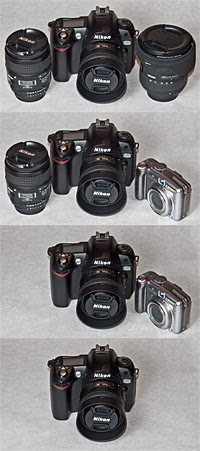

Nikon D70
Nikon 60mm Macro
Sigma 10-20mm
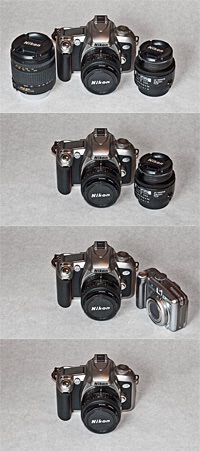
Nikon N75
Nikon 28-200mm
Nikon 24mm
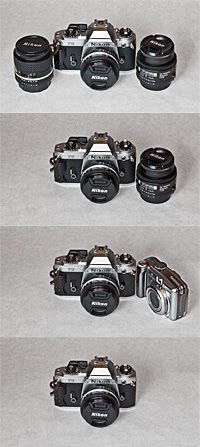
Nikon FG
Nikon 100mm
Nikon 24mm
I've got it easy, I like wide and macro. I bring only my super wide angle Sigma 10-20mm and my Nikon 60mm Macro (also doubles as a short telephoto, but the 105mm would be better still). If I want to go crazy (and I usually do), I throw in my small and lite 35mm f1.8, a great lens for candid and low light. Actually, a great lens all around and a worthy choice all by itself because it is small, lite, and offers a nice balance of not being too wide or too long.

The conventional wisdom says to just bring the super zoom. Sure, Nikon's 18-200mm has won praise and does seem to have it all. But is doesn't. First: it's huge, second: it's slow - f3.5-5.6 (Okay, for this range that is impressive, but still it's slow compared to primes): third: the wide end has so much barrel distortion that it borders on being a fish-eye. But, it does offer good macro performance.

Another option to make sure your are carrying what you will actually shoot with is get all your favorite photographs into a program like Lightroom or Picasa. Both these programs (and most others) will show you a lot of the detail recorded as meta data in each image. You can look through and see what your most used focal lengths are and that should be a good indicator as to what lenses you should bring.

In Picasa, you can see this data by double clicking on an image (so it fills the window) and then click on the little propeller beanie in the lower right side. In Lightroom, switch to the Library module and expand the Metadata tab on the right. The data might not be available if you have already processed the photo, saving the image will often strip this data from the file.

But maybe you need to go with as little gear as possible, maybe only one lens. That can be a tough call, unless you think outside the box a little. Here's my advice for going lite, find your single favorite lens and pack that. Don't worry if it's a macro or ultra wide angle, or long telephoto. You won't regret taking your favorite lens because, well, it's your favorite lens right? Now, to make up for what ever you are missing, grab your point and shoot.

Yep, it's that simple. Stop worrying about every shot being perfect, you'll get great shots with your big DSLR paired to your favorite lens, you will get the shots you really want and they will be great. For everything else, there will be that small point and shoot that is smaller than even an external flash for your DSLR. It will likely cover a wide range from wide angle to telephoto.

Other benefits of caring that point and shoot:

  • Video: Not only video, but good, easy video. Sure, some new DSLRs do video now, but they don't do it very well unless you have a film (as in motion picture film) degree and a boat load of lenses.
  • Range: Even modest point and shoot cameras have 3 to 6 times zooms, with 8 to 12 times zoom becoming more common. There are lot of compromises in these designs, but again, this is just to catch all the other stuff that is outside you main interest. And most have very good macro modes.
  • Options: Having a second, less expensive and much smaller camera gives you options. There may be times when traveling that you don't want to lug around a big clunky DLSR, or when it is not safe or just not feasible. But you can always slip that point and shoot into your pocket and remember, the best camera is the one you have with you.
  • More Options: There are a lot of water proof and ruggedized point and shoots coming out now. How about that, can your DSLR shoot under water or can you drop it six feet without breaking? What could be worse than a broken camera on vacation? That's a rhetorical question, I really don't want you to answer that.

I have a great little Canon A720 IS. Unfortunately it is no longer available, but Canon has plenty of similar cameras. Its focal range is equivalent to 35-210mm, does great macro, is relatively fast with a maximum aperture of f2.8, and has Image Stabilization to really boost it's low light performance. And shooting at ISO 80 and reducing its resolution from 8 to 5 or 3 mega pixels does help reduce the noise inherent with small point and shoot sensors.

Paired with my Sigma 10-20mm, I have an equivalent range of 15-210mm in much less space than what most people need for the equivalent of 28-300mm.

My point and shoot is also a great companion to the all around 35mm f1.8 (52.5mm equivalent) on my Nikon D70. I can pull it out when I need to go a little wider, or a whole lot longer.

Most DSLRs use the cropped sensor, so the lens length is different on these, but if you are lucky enough to have one of the professional level 'full frame' DSLRs, my favorite travel lens is a 24mm. It is great for architecture and people. I can shoot one person from head to toe, or a group of people without having to move back 30 feet. It lets me stay with them, almost like I'm part of the family and not just the photographer. You know, so I can actually be with my family on vacation. It won't do head shots though. Well, it will, you can get close enough, but you won't like the results. For that, and real low light situations, add a small and lite 50mm. If you still feel the need for the long telephoto, add a point and shoot. The Nikon 24mm is not much bigger than the Nikon 50mm and when paired to an Nikon N75, takes up very little space and needs only a small bag to carry. Yes, that's right, that's a film camera. Guess what, it works great for travel (and it is a lot cheaper than a full frame DSLR). The body is much smaller and so are older prime lenses so your whole kit gets much smaller. Sure, I have to carry around film, but I find it a lot easier to stash a few roles of film on my person than to make room for a big DSLR and its correspondingly huge lenses. And old film bodies are so cheap that you really don't have to worry about them. If they break or get lost, it is not the end of the world.

The N75 and its lenses are relatively large in comparison to a rangefinder and its lenses. If ultra portability is the goal, you really can't beat a rangefinder. But, they don't have any really long telephoto lenses, so if that's you bag, give rangefinders a pass.

And of course, you could just go with a point and shoot. The Panasonic LX3 is, by all accounts, a phenomenal camera, but it has very short range, 24-60mm. There are plenty of other great options these days. It seems like the camera makers have finally stopped with their insane megapixel arms race and are not making some cameras that really are better. Canon has done a nice job with the new G11 and the S90.

There is also a whole new field of cameras with good interchangeable lenses based on the micro four-thirds sensor, the Panasonic Lumix GF1 being my favorite. The Olympus PEN E-P1 being another favorite. Both are significantly smaller than a DSLR. Their sensors are in between a consumer DSLR and a point and shoot, but the image quality is much closer to that of the DSLR. These are essentially the modern version of the old range finders, and in the right hands, I have seen some startlingly good results.

Please, do yourself a favor and don't buy that ridiculous camera backpack. Do your really want to lug that to the top of a mountain, or even a small hill. Pack lite, pack to go, be ready to shoot. Don't waste time switching lenses. Don't risk dropping your prized lenses into a 1000 foot chasm. First and foremost, have fun when you travel, engage with the people around you and use only your single best camera with your signal best lens to get those truly memorable shots. Don't waste time with all the trivial shots everyone else is trying to get. Better to come back with three grade A shots that you print out and hang on your wall than 2000 snapshots that won't every go past your hard drive.

Wednesday, September 02, 2009

Showing Photographs at Northern Westchester Hospital

My work will be on display at the Northern Westchester Hospital in Mt. Kisco, New York from September 24th 2009 through March 15th 2010.

In response to the call for, "calm, peaceful, joyful, uplifting, colorful, bright, abstract or realistic", I picked several images from my water series and one large rose.

The reception for friends and family is on October 3rd, 2009 from 3pm to 5pm.


Arts & Edibles in Memory of Jonathan D. Pfeffer - 2009

I am participating in the second annual Arts & Edibles Fund Raiser in Memory of Jonathan D. Pfeffer benefiting the Lexington Center for Recovery.

I will have three photographs on display at Spinelli's Italian Restaurant in Mount Kisco on September 13th, 2009 from 2pm to 6pm.


Tickets cost $35 prior to the event and $40 at the door. For sponsorship information, artist participation or to purchase tickets, call (914) 666-0191 or visit the Lexington Center for Recovery web site.

Two trolleys will wind around the trail, making stops at various local restaurants at which attendees may dine on tasty treats. While enjoying the local cuisine, trolley riders can browse and purchase artwork from Hudson Valley artists on display at each location.

Participating restaurants include:

  • A Taste of Jamaica
  • Basilico
  • Big Apple Bagels
  • Cafe of Love
  • French American Bistro
  • La Camilia
  • Lefteris Gyro
  • Lexington Square Cafe
  • Mango Cafe
  • Passage to India
  • Pierros
  • Spinelli's
  • Starbucks
  • Temptation Tea House
  • The Fish Cellar
  • Tuscan Oven
  • Via Vanti
  • Woody's on Main

Friday, July 17, 2009

Cheap hotels and motels are better than fancy five star hotels

I have traveled a lot, both professionally and for pleasure. I have stayed at some complete dives as well as some great places, including five star hotels. Fancy hotels and five star hotels have been OK, from my point of view, worthy of only three stars. The cheap hotels and motels are generally first rate, four or five stars.

When I am traveling, I have simple needs. I want a clean room with a good shower and free WiFi. Nail those things and you get four stars. If your hotel/motel has a great location or the staff is especially helpful and friendly, you get another star.

Now let me pick on a couple of the five star hotels I've stayed at:

Ritz Carlton, South Beach
Sure, it was swanky, but they missed the details and that is what makes the difference between good and perfection. Location was good. But, the bathroom door was broken as was one of the side tables, that's pretty tacky, -1. No free WiFi, super tacky, -1. We checked in late with a tired two year old. We wanted to go straight to bed, but a knock at the door at 10pm wakes the baby. It's a steward with a some late night night complementary snack or something. Hello, we just checked in with a tired two year old! Thanks for waking him up, now get out! -1. Five minus three leaves you with two stars, bravo.

Wynn, Las Vegas
Impressive if odd designed rooms, very, very big, very spacious, totally over the top. The bathroom was bigger than most motel rooms I've stayed at. Not my style, but it is top tier for what it is. We had some trouble when checking in as well as some billing issues, but the staff were very responsive and acted with a great deal of professionalism. They knew they were working at a five star hotel and were more than up to the challenge. Rooms were clean, shower was great. But, no free WiFi, very tacky, -1. Seriously, it costs you next to nothing to offer this to your guests, you offer free HD TVs with free cable, that costs considerably more than free internet access. And the internet access charge was not all that much, so it is not like it's a big profit center, it's just tacky. Tacky, tacky, tacky. That leaves the Wynn as a four star.

Some Nameless Five Star Hotel in Shenzhen, China
I went there in 2000 and only stayed there one night and I just can't remember anything about it other than it cost me a whopping $34, it was beautiful, and the staff were great. I have vague recollection that it did have free (or maybe really, really cheap) wired internet access (2000 would have been a little early for WiFi). OK, fair enough, that really was a five star hotel.

Compared to The Holiday Inn Express in Quakertown, PA
Clean room, free WiFi, friendly staff, and though I have not tried the shower yet, the best lit bathroom I've ever seen. It's like a professional lighting studio. Not only is the WiFi free, it's also trouble free, no stupid sign in screens. I hopped on the network from both my iPod touch and my laptop. It's a little early to be calling this one, but it's at least a four star with a good chance of another star.

See, what is comes down to is, you just have to make me comfortable and happy. Oh, and don't be tacky.

What really annoys me is that all the fancy hotels have free cable TV, but I honestly can't remember the last time I turned on a TV in a hotel room. Yet, the one cheap thing that I really want, free WiFi, I have to pay for. And I have to pay for it each day. The cost is usually $10 to $15 a day. So, in as little as three days, I get to pay the hotel for internet access as much as I pay at home for a whole month!

Saturday, July 11, 2009

Texas Furniture Makers Show 2009

Ten years! The TENTH Annual Texas Furniuture Makers Show will be held in Kerrville, TX and run from October 22 to December 5, 2009.

More information and entry form can be found at the KACC web site.

The Kerr Art & Culture Center has rounded up another great set of judges for this year's show:

  • Jonathan Binzen of New Milford, CT is a nationally known craftsman, author, contributing editor for Fine Woodworking Magazine and photographer specializing in furniture and architecture.
  • Spider Johnson of Mason, TX is a professional artist, writer, furniture maker, wood marquetry master and musician.
  • Curtis Whittington of Boerne, TX is a professional furniture maker and master craftsman.
Two dozen woodworkers have already been accepted into the show during the early registration period. If you are a Texas furniture maker, hurry to get your entry application in before August 15th.

As in past years, there will be a review with the judges the day after the reception. This is one the the smartest and most valuable programs any furniture show anywhere does.

Also, this year's continuing education will be, "The Contemporary Scene in Handmade Furniture" by show judge Jonathan Binzen.

The reception and awards ceremony will be on November 7th, 2009.

Cash Awards:
First Place - Best in Show: $1000
Best Craftsman Award: $750
Best Design Award: $750
Best Contemporary Style Furniture: $750
Best Traditional Style Furniture: $750
Best Texas Style Furniture: $750
Best Whimsical / Art Furniture Style: $750
Woodcraft's People's Choice: $300
Best Apprentice Furniture Maker: $250
Hill Country Turner's Choice Award: $100

Wednesday, July 08, 2009

Google OS

Announced today, Google will create a computer operating system to compete with Microsoft Windows, Apple OS X, and Linux named Google Chrome OS.

Initially, Google will be making Chrome OS for netbooks, a smart place to start as there are fewer compatibility issues with the simpler netbook computers. It is a good place for Google to cut its teeth on a new operating system. Google is currently working with netbook vendors and reports that Chrome OS will be shipping on netbooks by the middle of next year. After that, the implication from their announcement is that it will work its way up into laptops and then desktops.

Will it run Microsoft Office? Will it run Adobe Creative suite? Will it run games? This question is more up to the creators of those applications than it is to Google. Microsoft, Adobe, and game makers will have to develop their applications for Chrome OS. Will they? This is a very important aspect of Chrome OS to watch, which application developers commit to creating, or porting, their applications for Chrome OS?

Will Chrome OS become a full operating system like Microsoft XP/Vista/7, Apple's OS X, and Ubuntu? It is too early to tell really what Google's full intentions are. They may be only targeting the casual netbook market. That market is both small and vulnerable. It is an awkward market as it sits between ever improving Smart Phones that are much smaller and full on laptops that are much more capable. Netbooks don't generally fill the role as a primary computer, they are secondary machines for convenience. Because of this the whole netbook category may just disappear. And there is a chance that if Google is not quick enough, Chrome OS might slip away with it.

Personally, I am very interested in Chrome OS. I use XP everyday and OS X a couple of times a week. I would use OS X more, except that the applications I use everyday are on XP and, as a web designer, I have to test my work on the most common browser, Internet Explorer anyway. Thankfully I am savvy enough to keep my machine clean without having to run any crushingly awful anti-virus software.

But, it sure would be nice to have a cleaner, faster, and more reliable operating system. There is by no means any guaranty that Google can deliver, I am wary as to whether or not they can deliver. For comparison, their web browser Chrome is great and it is my primary browser. But, I am typing this post out in Firefox because, ironically enough, Blogger (a Google property) does not work well inside Chrome. If Google can't get its own web applications to run perfectly in their own browser, how well are they going to be able to get everyone elses applications to run on their own operating system?

Another interesting question is who does this hurt and who does this help?

On the hurt side, Microsoft is the obvious target. As Rob Enderle said, "This is the first time we have had a truly competitive OS on the market in years. This is potentially disruptive and is the first real attempt by anyone to go after Microsoft." Except, of course, it is not. Rob apparently has not heard of a small company down in California called Apple. Which is funny as he tries to pass himself off as some kind of PC industry expert. I guess Rob has not noticed Apple's ever increasing market share? Or that on several college and university campuses Apple usage is over 20%? He also seems to be jumping the gun a bit here, Google does not yet have Chrome OS out. And their first foray into netbooks is a year away. So, it's not really, "...on the market.." He, and most other 'industry pundits' seem to be missing the story hear, I guess due to their Microsoft bias.

The interesting question is, how does this really effect the market? My best guess is that it has potential to hurt Apple more than Microsoft. This is because people who have a choice in what operating system they use often look for something better, faster, more reliable, and easier to use. Regardless of what fanboys on either side say, that better operating system is OS X. It is easier, it is faster (mostly), it is more reliable. It is my humble opinion that most people who use Windows are either forced to because of business issues, or they just don't know enough to look at something else. Microsoft clearly has a hold on the business community with applications like Exchange, Outlook, and MS Office. At least for the moment, Google Wave may change that. And I think Wave is more of an immediate threat to Microsoft than Chrome OS is because it might open up the business market. If that happens, the operating system people choose to use will be much less important. That, in turn, opens the door for competing operating systems to go up against Windows.

But back to why Chrome OS is bad for Apple. If Chrome OS looks to be a really strong operating system, it might draw away application developers from the Mac platform (OS X). That would be bad, because, as Steve Ballmer once said, "Developers, Developers, Developers, Developers, Developers, Developer...." Good developers (who seem to be turning more and more to the Mac) are what drive great applications and that in turn drives the market. If Apple looses developers, Apple is less relevant.

Also, because most Apple users have a choice in what operating system they use, they can switch much more easily. If Chrome OS is as good or better then OS X, then Apple has a real problem. Except that Apple is a smart and creative company that may well figure out a way to be more competitive. Apple's reaction will be very interesting. Google and Apple are quite friendly, and they will both be running on the same core (Linux). Who knows, maybe Chrome OS will be sold on Apple hardware, maybe Chrome OS will become OS 11 (because ours goes to 11)? This is just crazy talk at this point, but with Apple and Google, I don't take anything for granted.

Monday, July 06, 2009

Artist


Jeff Reese, AKA, "Solomon Kane" is a cool guy. He is a big guy, an imposing guy, a gentle guy, a sympathetic guy, a caring guy, a giving guy, a thoughtful guy, a trustworthy guy, a religious guy, a philosophical guy, a surprising guy, and a creative guy. Definitely a creative guy.

I met him many years ago when I lived in Houston and had a gallery. I was a little suspicious of Jeff the first time I met him. At the time, I was not used to people being so forthright and it threw me a little. But, thankfully for me, it did not take long to realize what Jeff is, Jeff is true.

He is a cop. He also makes trippy, colorful, crazy, and mind-bending paintings.

The point of my rambling is that I was very happy to see that he has been getting some press lately. Bravo Jeff and good luck.

Saturday, May 30, 2009

Google Wave

What is Google Wave?

Google Wave is a 'next generation' email system. It takes cues from Gmail and builds a new model for conversation over the web. A simplistic way of looking at it is to say that it is a mash up of an email app, IM client, Wiki, blog, and photo sharing site. A more sophisticated way of seeing it is as email reimaged, or thinking about how one would build a communication system on the web starting from scratch.

Google Wave not only changes how we use email, but also how the nuts and bolts of it work. Resources (like images) are uploaded once and then shared where ever they need to be, in a document, a photo album, a blog, etc... And Wave will allow 'drag and drop' of images (and maybe other files?) into the browser directly from your desktop onto the web.

Instant Message or Email? Yes, both.

Currently, during an Instant Message conversation, each person waits while the other types. No more, as one person types, the other sees each word, indeed each letter, as they are typed. This instant and continual connection is what dissolves the line between what an email is and what an instant message is. Conversations can be conducted as they would in a current email environment, or can be treated like a chat session.

You say 'Conversation' I say 'Wave'

One of Gmail's innovations was the inventions of 'conversations'. In the 'old days', emails would be bounced back and forth between users and would whined up scattered across the inbox. But Gmail automatically consolidated all these emails into on expandable conversation. The new basic unit in Google Wave is simply called a Wave which is basically the same thing as a current Gmail conversation, but on steroids (legal ones of course). A Wave can be replied to like a conventional email, or the recipient can insert a reply anywhere in the original wave, so the reply has context. In addition, the recipient can edit the original email, treating it like a collaborative document.

This free wheeling editing capability could get confusing and downright dangerous if not for a basic feature built into the frame work of Google Wave: a timeline. This timeline can be used to 'roll back' the conversation within the wave to see who added or deleted what and when. It is a simple and intuitive method of tracking changes and makes this whole email thing much more elegant. You can seamlessly flow from a typical 'email' into a collaborative document to a chat and back again, the hole time being able to see exactly where the story started and how it grew.

Bona Fide


If it is not clear just how big of a step forward this is, know that Wave is from the same guys who did Google Maps. Google Maps completely revolutionized online maps. Every other mapping system has been chasing (copying) Google Maps for years. I expect the same will be true of Wave.

Mobile Integration

The developers of Google Wave have worked very hard to make all different kinds of communication seamless. Wave can be used like the email you know and love or like IM. But the developer's zeal for seamlessness did not stop there, they built the system from the ground up to work beautifully both on your desktop and on your mobile phone. There certainly is a difference between the mobile and desktop versions, but the parity between them far exceeds the differences.

For you, for me, it's free, it's Open Source.

Not only is the design and functionality of Wave extraordinary, but so is Google's approach to the platform, they are giving it away. Anyone can download and install Wave on their own server and run with it, no strings attached. The code is open and the dev team has made is easy to create 'extensions' that make Wave do what you want it to do. This is extremely powerful, what we have seen of Wave so far really is just the early iterations of the dev team, but Wave is more a frame work than a final product. I expect that Wave will evolve in many different ways in the coming years and that has the power to solidify it's continued success.

But when a developer takes Wave and makes it his own, that does not leave the developer on his own lonely product fork. Nope, Google Wave is designed to work with variants of itself. You can customize it and still have it play nice with someone else's customized Wave.

Plays nice with social networks

As I mentioned at the top, one of the core ideas is to create the content once and share it where every you want. That means plopping a Wave component down into your FaceBook page, should you be so inclined. Post a 'Wave' to blog? Sure thing, and it retains all its 'Wave like' properties. If you update the Wave, the Blog reflects that change as you change it.

Powerfully extensible

Google not only lets people mess with Wave, they want people to mess with Wave. The Wave dev team created a simple API for creating extensions. By doing this, they have invited a lot of people to the party. Think about how successful Firefox has become, in no small part because that is what they did. There are thousands of extensions for Firefox that let it do all kinds of things from grabbing video from YouTube to notifying you when you have a new email. Google is not staffed by dummies and they are not to proud to take a play out of the Firefox's playbook.

The Wave dev team has built a few of their own extensions to get the ball rolling. One of the most impressive is Rosie that instantly translates Waves into your language, letting you chat (in real time) with someone typing in a foreign language.

Other examples of Wave's extensions are:

  • Integrated with Twitter
  • Play Chess in real time in a Wave
  • (the aforementioned) ability to automatically post a Wave to a blog
And in this corner, from Redmond, Washington...

Wave is in beta now, open only to a select group of developers. It is scheduled to be released at the end of the summer (2009). As it stands, one glaring omission from Wave is calendar functionality. I have little doubt that it will be added in at some point. Maybe it is such a large feature set that it was not ready for the preview. Or maybe that functionality will be added through an extension. Or maybe, just maybe Google did not want to scare Microsoft too much.

I can not know or speculate if Google intentionally targeted Microsoft's Exchange server (that runs most company's email systems) or if the threat that Wave posses to Exchange is just a byproduct of Google's desire to build the next generation internet communication platform. Either way, Wave certainly is the scariest thing to happen for Microsoft since Firefox. In fact, it is significantly scarier.

If Wave proves to be reliable and secure, Exchange will have a competitor like nothing it has seen before. IT departments around the world will have the option of a wildly powerful, extensible, and controllable communications platform in Wave. And it is free. Compared to a buggy, semi-secure, closed, and expensive alternative (Exchange).

Wave lacks two things that Exchange has; Exchange is the leader so it is what IT departments know, and Exchange has integration with Outlook's calendar features. Outlook lets a company know who is doing what, when, and where. It is a massively powerful tool. If and when Wave adds similar (or, based on what we have seen from Wave so far, superior) features, Microsoft will be in real danger of loosing it's grip on the business market and by extension, it's grip on the operating system market. Oh, did I not mention, because Wave is completely web based, it does not matter what operating system people are using to access it, it is all the same. Unless you are running Internet Explorer which was distinctly absent from the list of browsers that Wave will work in. But then, if you are still running Internet Explorer, you have bigger problems...

There is a lot of work still to do on Wave, and a lot of ground it has to cover before it can even be considered a threat to Microsoft. But, in my mind, it is the first real challenge that could be a serious threat to Microsoft as a whole.

And to be frank, Microsoft does not look to be in a position to deal with a serious competitor right now. They look better now than they have for years, they are set to release Windows 7 that may be their first operating system that does not suck since Windows 2000. They recently launched their new search engine, 'bing' that also does not suck. It may even be on par with Google. But, 'not sucking' is no way to compete with a serious threat. And when you release a new product, it can not be 'just as good as', it needs to be better, otherwise who cares?

Tuesday, May 19, 2009

Third Place

I was awarded third place in the photography catagory for Mega-Mum at this years Katonah art show.

Mega-Mum